
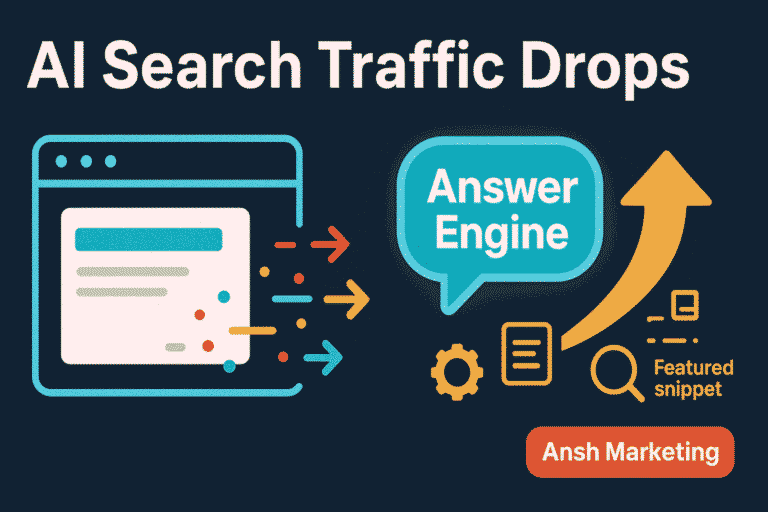
AI Search Traffic Drops: Why Websites Are Losing Clicks to Answer Engines Like Perplexity & ChatGPT Search and How to Recover
The way that people search the information is changing relatively quickly. As more individuals use AI-based answer engines such as Perplexity and ChatGPT Search, many of them are receiving direct answers from AI rather than clicking on the resulting web pages. As a result, many webmasters and marketers have begun to notice that their website traffic has decreased. This article aims to explain the reasons why this is happening, what it means for your business, and how you can adjust accordingly so that your business can eventually recover traffic.
Why AI Search Is Affecting Website Traffic
Because AI-based search engines provide quick answers to user questions, users are able to obtain answers directly from AI without needing to click on multiple web pages to locate the information they need. While this is beneficial for users, it also means that webmasters benefit less through website clicks than through their previous methods of obtaining traffic. There are a few key reasons why AI search engines are changing the way that webmasters attract visitors to their websites:
Direct Answers Reduce Clicks: The first reason is that AI answer engines provide direct answers, therefore eliminating any need for users to click through to the original site that they would have gone to otherwise.
Changing User Habits: Secondly, due to the convenience associated with obtaining quick, concise answers, users today prefer to receive their answers quickly rather than they do when browsing through multiple pages for information.
Search Engine Changes: Thirdly, many of today’s Search Engines are now using AI technology as a component of their search results, therefore decreasing the prevalence of traditional organic listings within the SERPs.
Featured Snippets & AI Summaries: Fourthly, AI often pulls content for summaries from the top-ranking sites, leaving less chance for individual pages to get clicks.
Evidence That Websites Are Losing Traffic
Over the last few months, several website owners have reported a decrease in their click-throughs as traffic has decreased. Decreased traffic in particular industries includes:
Health and wellness
Technology and gadgets
Finance and investing
How-to guides and tutorials
As an example, a “best-skin-care-routines” blog receives fewer clicks because there are AI tools that can analyze and summarize what the blog says to give an individual the answer without needing to visit the website.
How AI Answer Engines Work
AI search engines, such as ChatGPT and Perplexity, utilize large datasets taken from various sources. Here is a summarised breakdown of how the AI search engines work:
AI search engines analyse and interpret web pages with Natural Language Processing to understand the content.
The AI search engines utilise their databases of multiple sources to compile all necessary information to develop a shortened summary to answer the designated query.
The AI search engines may not link back to the source of their response, which means that Website Owners may not receive clicks from their site.
In short, AI search engines are not intended to replace websites, but their design allows individuals to access information from many different places on the internet.
What This Means for Businesses and Content Creators
The decline in traffic on your website can negatively affect:
Revenue from ads or products
Visibility and authority in your niche
Engagement on your site
But it’s not all bad news. By recognising these recent changes, you will be able to revise your strategy to maintain your visibility and relevance.
How to Recover Traffic in the Age of AI Search
Here are practical strategies to help your website stay competitive:
1. Optimize Content for AI Answers
When writing for AI/ML readers, you need to write clear and concise answers based on frequently asked questions in your industry or subject area. To this end, using bullet points, numbered lists, simple sentences and paragraphs are great ways for an AI/ML reader to gain an understanding of the type of content you produce.
2. Use Structured Data (Schema)
Schema markup adds rich data to your website that will allow an AI/ML model to better understand your content and provide an increased likelihood that your content will be featured as a result of AI/ML searches (i.e., in a list of search results).
3. Focus on Authority and Expertise
To create content that demonstrates your experience and expertise within your industry, you should create long-form, in-depth articles. To do this, you should include as many references, case studies and real-world examples as possible.
4. Increase Engagement
You can create additional engagement on your website by adding multimedia (e.g., images, videos) and interactive content. You can also encourage comments and shares from your users to provide a means of engagement that cannot be replicated by AI.
5. Diversify Traffic Sources
Your website should not be solely reliant on search engines for its traffic. Instead, you should diversify your traffic sources, including using email marketing, social media and referrals.
6. Monitor AI Impact
You should measure how much of an impact AI has had on your website’s traffic by using web analytics tools. Based on the results of these analyses, adjust your strategy accordingly to generate the highest level of traffic within your niche.
The Future of AI Search and Websites
AI will continue to remain an integral component of search results, and the manner in which people access information will change accordingly. The best websites will adapt to the new environment, maintain their authority and provide a unique value proposition.
The key is to think like AI: Give simple, direct responses; provide structured and organised materials; ensure that your web presence is highly regarded as a reputable source.
Conclusion
AI Answer Engines’ increasing popularity is transforming how individuals search the web/what type of sites they use for searching pressures Many websites are losing traffic; however, this does not preclude content authors from growing their audience base. Understanding what AI is, Optimising Your Content for Search Engines, Creating Authority as an Expert in Your Field, Will Transition Your Audience and potentially repealing and expanding the audience base during this new wave of digital growth and transformation.
Changes occur naturally; however, there will always be a need for value-oriented and clear websites regardless of technology, including AIs.
FAQs About AI Search Traffic Drops
Why am I losing website traffic to AI search engines?
AI engines provide answers directly, so users don’t need to click through to your website. This reduces organic traffic from search engines.
Does this mean websites will become useless?
No. Websites are still important for in-depth content, credibility, and engagement. AI encourages creators to focus on quality content.
How can I make my website visible to AI engines?
Use structured content, schema markup, concise answers, and authoritative writing. This increases the chance AI will reference your site.
Which industries are most affected by AI search?
Blogs and sites providing answers (health, tech, finance, tutorials) are most affected, while entertainment, forums, and unique brand content are less impacted.
Should I stop relying on search engine traffic?
Not entirely. You should diversify traffic sources by using email marketing, social media, partnerships, and direct engagement.